Strength Training & Exercise Equipment
What I Learned From Comparing Different Types of Resistance Bands
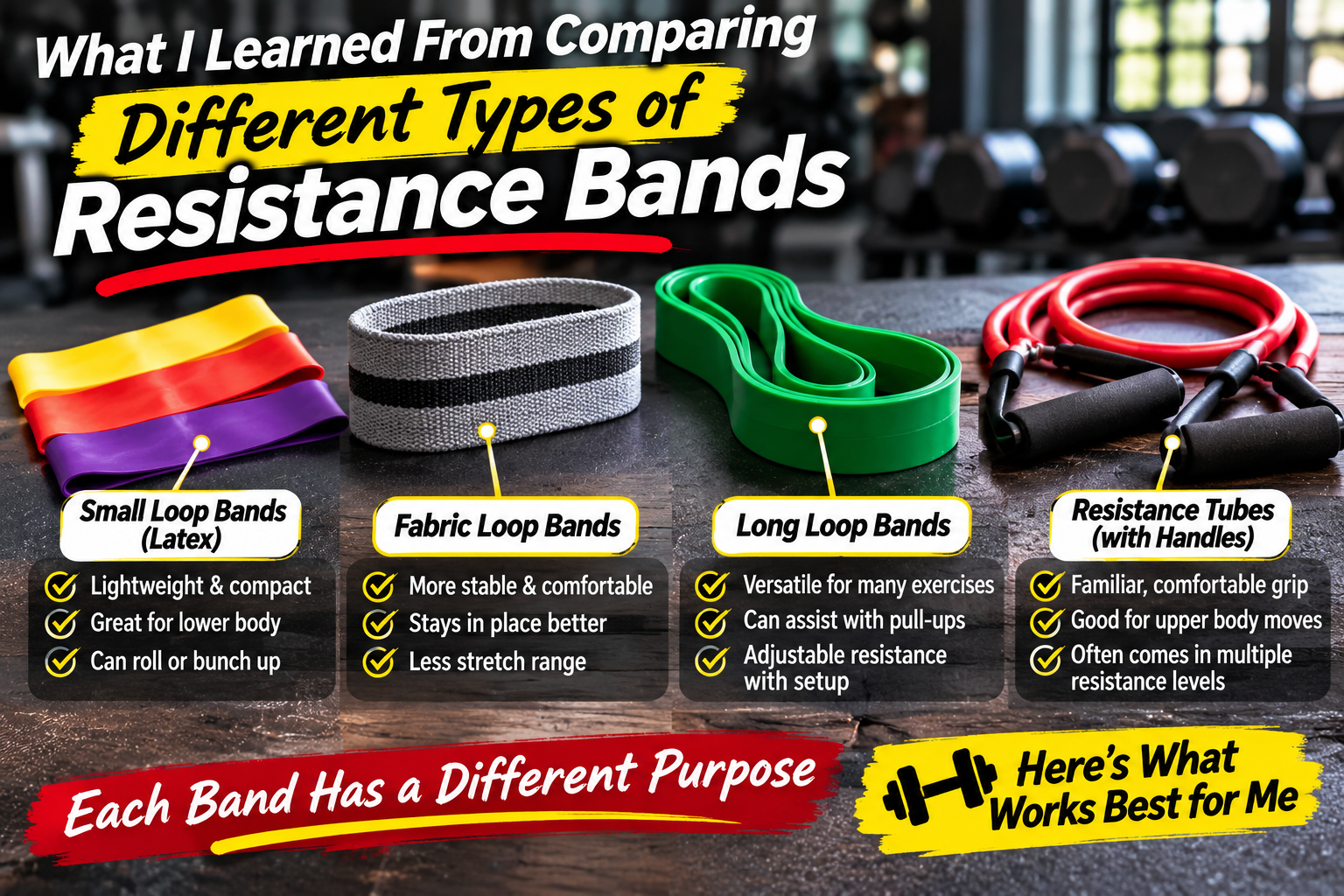
When I think about strength training, I usually picture dumbbells, barbells, and exercise machines. Those are the tools I use most often because they make it relatively easy to adjust resistance and track my progress. Resistance bands seem much simpler, but I've become interested in how different types of bands can serve different purposes in a fitness routine.
At first, I thought resistance bands were mostly interchangeable. They came in different colors, sizes, and thicknesses, but I assumed the main difference was how difficult they were to stretch. The more I looked into them, the more I realized that their design can affect which exercises they're useful for and how comfortable they feel.
One of the first distinctions I noticed was between flat loop bands and long loop bands. Flat loop bands are usually smaller and designed to fit around the legs, while long loop bands provide more room for exercises involving the upper body or larger movements. Both use elastic resistance, but their sizes make them better suited to different situations.
The smaller loop bands are particularly interesting for lower-body exercises. I can place one above my knees for lateral walks, controlled squats, or other movements that involve keeping tension against the band. They don't necessarily replace heavier leg exercises, but they can add a different challenge to movements that might otherwise feel easy.
I also like that smaller bands don't require much space. They're easy to keep in a gym bag or use at home without setting up equipment. For someone who already spends plenty of time lifting weights, having a simple option for occasional accessory exercises can be convenient.
However, I noticed that not all small loop bands feel the same. Some are made from thin latex, while others use thicker fabric with elastic material inside. The difference isn't just appearance because the material affects how the band stretches, grips clothing, and feels against the skin.
Latex loop bands tend to be lightweight and compact. They can provide useful resistance without taking up much room, which makes them appealing for travel or quick exercises. The downside is that some can roll or bunch up during certain movements, especially when they're placed around the thighs.
Fabric bands often feel more substantial. Their wider design can help them stay in position during exercises like lateral walks or glute bridges. I can see why someone might prefer them when comfort and stability matter more than having the smallest possible piece of equipment.
The trade-off is that fabric bands aren't necessarily as versatile. Some have a more limited stretching range, and their thicker construction can make certain movements awkward. I wouldn't assume that a fabric band is automatically better just because it feels sturdier.
Long loop bands offer a different set of possibilities. These are the large continuous bands that can be stretched between the hands, anchored around suitable equipment, or used for assisted exercises. Their length makes them useful for movements that smaller loop bands simply can't accommodate.
One application that interests me is assisted pull-ups. A properly secured long loop band can provide upward assistance, reducing some of the body weight I need to lift. That could be useful for practicing the movement, although the assistance changes throughout the repetition and doesn't feel exactly like an assisted pull-up machine.
Long loop bands can also be used for rows, presses, and other exercises when they're anchored appropriately. I like the idea of having equipment that can support several movements without requiring multiple machines. At the same time, I have to pay attention to where the band is attached and whether the anchor is secure.
Another type I've compared is the resistance tube with handles. Unlike flat loop bands, these usually consist of an elastic tube with a handle attached to each end. Some sets also include door anchors or interchangeable tubes that allow different resistance levels.
The handles make certain upper-body exercises feel more familiar. A standing chest press or biceps curl with a tube can resemble the hand position I would use with cable equipment. That doesn't mean the resistance feels identical, but the handles can make the equipment easier to grip.
I also noticed that resistance tubes can be more convenient for exercises where holding a flat band would become uncomfortable. Instead of wrapping elastic material around my hands, I can use the handles as intended. For longer sets, that difference in grip comfort might matter.
The biggest distinction between resistance bands and traditional weights is how the resistance changes during movement. A dumbbell has a constant mass, although the torque on my joints changes with the exercise position. An elastic band generally produces more tension as it stretches farther.
That means the hardest part of a band exercise may occur at a different point than with a dumbbell or machine. During a band curl, for example, the resistance can increase as I pull the band upward. The exact feeling depends on the band's length, how much it was stretched initially, and the direction of the movement.
I think this is important because a band labeled as providing a certain number of pounds of resistance doesn't necessarily behave like a dumbbell of the same weight. The advertised resistance may apply only at a particular amount of stretch, and manufacturers don't always measure their products the same way. Comparing two bands based entirely on the number printed on the packaging can therefore be misleading.
I've also learned that color isn't a reliable way to compare resistance across different brands. One company's red band might provide much more tension than another company's red band. I'd rather look at the manufacturer's specifications and test how the band feels during the exercise than assume every color represents a universal resistance level.
Another factor is the band's starting length. If I use a shorter band for an exercise, it may already be under considerable tension before I begin the movement. A longer band might allow a greater range of motion with a more gradual increase in resistance.
This makes selecting a band more complicated than simply choosing the thickest one. I need enough resistance to make the exercise useful, but I also need to move through the intended range of motion with control. A band that becomes nearly impossible to stretch halfway through a repetition isn't necessarily helping me perform the movement effectively.
I also think resistance bands can be useful for exercises that don't require heavy loading. Movements involving the shoulders, hips, or smaller muscle groups sometimes benefit from relatively light resistance and careful control. A band can provide a convenient way to add resistance without immediately reaching for a heavier dumbbell.
However, I don't assume that every band exercise is automatically a rehabilitation exercise. Certain movements may be useful in physical therapy, but the appropriate exercise and resistance depend on the individual and the reason for treatment. If I were dealing with an injury or persistent pain, I'd want guidance from a qualified healthcare professional rather than choosing exercises based on online demonstrations.
For general fitness, I'm more interested in using bands as another training option. I don't need to replace exercises that are already working well for me. Instead, I can consider whether a band makes a particular movement more convenient, comfortable, or practical.
Travel is one situation where bands have an obvious advantage. Carrying dumbbells in luggage isn't realistic, and I can't assume every hotel will have a useful fitness facility. A few lightweight bands can provide options for resistance exercises without taking up much space.
I still wouldn't expect a travel workout with bands to feel exactly like my regular gym sessions. Depending on the resistance available, some exercises might be too easy or difficult to load progressively. But if my goal is to maintain activity during a short trip, having a portable option can be helpful.
Another consideration is how bands fit into progressive overload. With dumbbells, I can usually increase the weight in clearly defined increments. With bands, I might need to switch to a thicker band, adjust my starting position, or change the amount of stretch to increase resistance.
That can make tracking progress less precise. If I move my feet farther apart during a band curl, I may increase the tension without knowing exactly how much additional resistance I'm using. For someone who likes comparing performance between workouts, that uncertainty can be a disadvantage.
I could still track progress by using the same band, starting position, range of motion, and repetition target. Keeping those variables consistent would make it easier to judge whether an exercise is becoming more manageable. It just requires a slightly different approach than recording the weight on a machine.
Safety is another reason I pay attention to band quality. Elastic materials can wear down over time, especially when they're repeatedly stretched, rubbed against rough surfaces, or stored improperly. A damaged band could snap during an exercise, so checking for cracks, tears, and other signs of wear is important.
I would also avoid stretching a band beyond the manufacturer's recommended limits. Even a high-quality band isn't designed to withstand unlimited tension. Using suitable anchors and keeping the band away from my face during movements where it could recoil are sensible precautions.
Latex allergies are worth considering as well. Some resistance bands contain natural rubber latex, which can cause allergic reactions in susceptible individuals. Fortunately, there are latex-free options, but I would still check the material specifications rather than assuming a particular band is safe.
After comparing the different designs, I don't think there's one type of resistance band that is best for every exercise. Small latex loops are compact, fabric loops can be comfortable for certain lower-body movements, long loop bands offer versatility, and tubes with handles can make some upper-body exercises easier to grip. Each design solves a slightly different problem.
What matters most to me is choosing equipment based on what I actually plan to do with it. Buying a large collection of bands doesn't make sense if I only need one or two for occasional exercises. I'd rather start with a specific purpose and select the type that fits that movement.
I've also realized that resistance bands don't need to compete with traditional gym equipment. Dumbbells and machines remain useful for measurable resistance and structured strength progression, while bands offer portability and different resistance characteristics. Both can have a place in a routine without one replacing the other.
My biggest takeaway is that resistance bands are more varied than they first appear. Their shape, material, length, and resistance characteristics all influence how they perform. Understanding those differences makes it easier to choose a band for a specific exercise instead of relying on color, thickness, or packaging claims.
For now, I see resistance bands as a practical addition to my fitness options rather than something I need to build my entire routine around. If a band helps me exercise while traveling, adds variety to an accessory movement, or makes a workout more convenient, that's already useful. Sometimes the best equipment isn't the most complicated or expensive option, but the one that makes a particular exercise easier to fit into my life.
Make sure to check out the Kato Tam fitness coach website for workout tips, daily nutritional insights, fitness motivation and more!