Strength Training & Exercise Technique
The Difference Between Using a Wide Grip and a Narrow Grip During Strength Training
For a long time, I didn't pay much attention to where I placed my hands when lifting weights. If I was using a barbell or a cable machine, I'd usually grab whatever position felt natural and start exercising. I figured the important things were how much weight I was lifting and whether I was performing the exercise correctly.
Eventually, I started noticing that the same exercise could feel surprisingly different depending on how far apart my hands were. Moving my grip a few inches could change which muscles seemed to be doing most of the work, how far I could move the weight, and whether the exercise felt comfortable.
It made me realize that grip width wasn't just a minor detail. It was another part of an exercise that I could adjust depending on what I wanted to accomplish.
How I Started Noticing the Difference
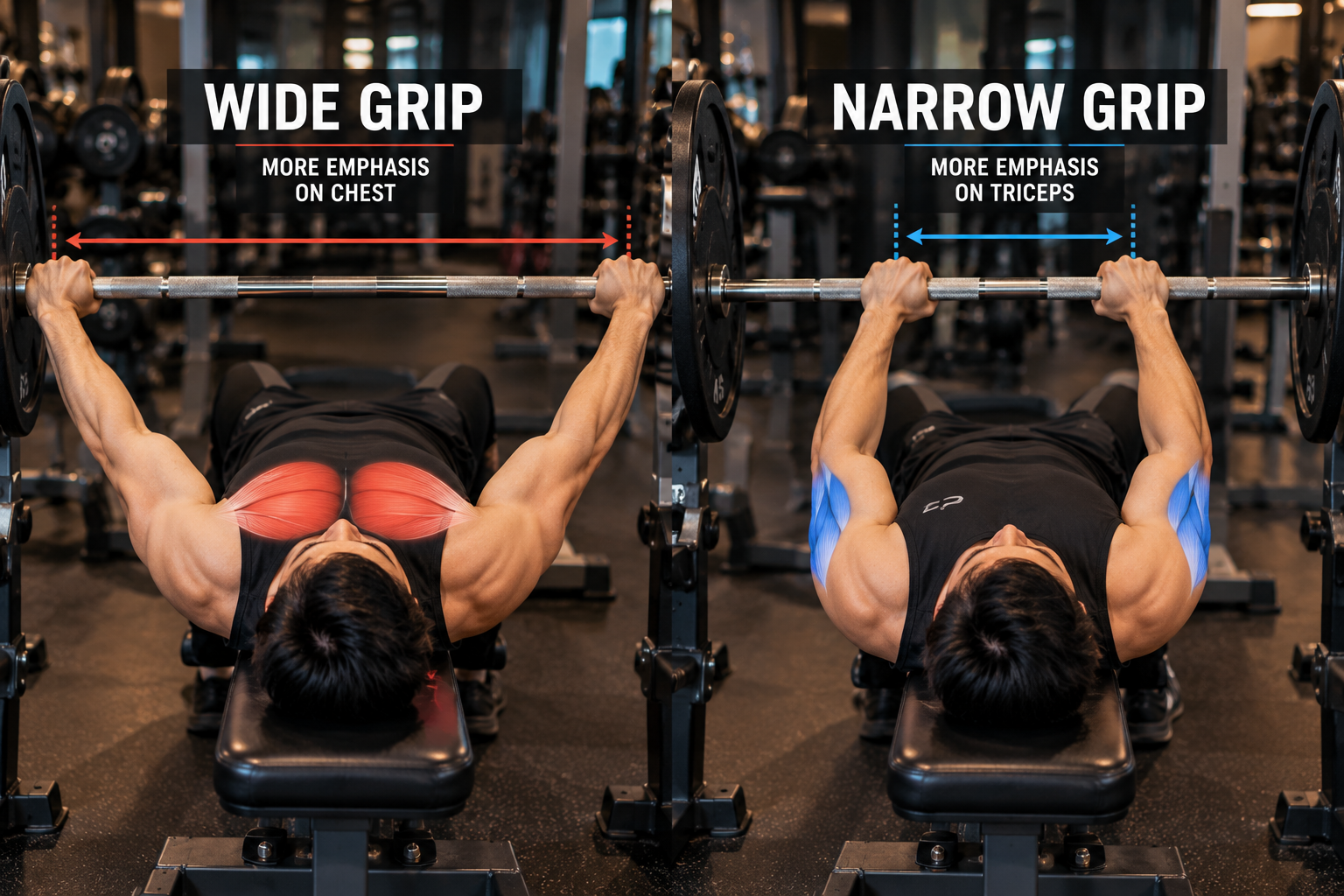
The bench press is one of the easiest examples. With a wider grip, my hands are farther apart, and the bar generally travels a shorter distance before reaching my chest. With a narrower grip, my elbows tend to stay closer to my body, and the movement feels different through my arms and shoulders.
A narrower grip also tends to make my triceps work harder, which can make the exercise feel more challenging even when I'm using less weight. That doesn't mean a wide grip completely removes the triceps or that a narrow grip stops training the chest. Both muscle groups are still involved, but their relative contributions can change.
I used to assume that if one grip allowed me to lift more weight, it must automatically be the better option. Now I understand that comparing the numbers isn't always meaningful when the mechanics of the exercise have changed.
If I'm deliberately changing my grip, I'm also changing what I'm asking my body to do.
Pulling Exercises Can Feel Different Too
I notice similar differences when using a lat pulldown machine. A wider grip changes the position of my arms and the path of the movement, while a closer grip can allow my elbows to travel farther down and back.
For me, the closer position often feels more natural because I can concentrate on pulling my elbows toward my sides rather than simply trying to bring the bar down. A wider grip can still be useful, but I don't automatically assume that spreading my hands as far apart as possible will give me a better back workout.
There's a common idea that using an extremely wide grip is necessary to build a wider back. In reality, the muscles involved depend on several factors, including shoulder position, elbow movement, range of motion, and the specific exercise. Grip width alone doesn't determine the result.
I've also noticed that different machines can make these comparisons less straightforward. A pulldown station with angled handles might feel completely different from one with a straight bar, even when my hands are approximately the same distance apart.
That's one reason I don't think there's a universal grip width that works best for everyone.
Comfort Matters More Than I Used to Think
One of the biggest things I've learned is that a grip doesn't have to feel uncomfortable to be effective. Sometimes I'll see someone using a very wide grip and wonder whether I should be doing the same thing. But if that position makes my shoulders feel awkward or prevents me from controlling the movement, I don't see much benefit in copying it.
Body proportions make a difference. Someone with longer arms, broader shoulders, or different joint mobility might find a particular grip comfortable while I find it awkward.
I've become more willing to adjust my hand position instead of forcing myself to match a demonstration exactly. A small change can sometimes make an exercise feel considerably smoother without changing the equipment or the overall movement.
Of course, there's a difference between an exercise feeling challenging and experiencing actual pain. If a grip causes sharp pain, persistent discomfort, or unusual joint symptoms, I wouldn't treat that as something to push through. Changing my grip might help with an awkward position, but it isn't a substitute for getting an injury or ongoing pain properly evaluated.
Wider Doesn't Always Mean Better
Something else I've stopped assuming is that a wider grip automatically makes an exercise more advanced or effective. Sometimes it simply changes the leverage, reduces the available range of motion, or places the joints in a different position.
The same goes for narrow grips. Bringing my hands closer together doesn't automatically make an exercise better for building muscle. Depending on the movement, it might emphasize a different muscle group or make the exercise harder to perform comfortably.
I've found it more useful to think about the purpose of the exercise first. If I'm trying to emphasize my triceps during a pressing movement, a moderately closer grip might make sense. If I'm training my back, I might choose a grip that lets me move through a comfortable range of motion while maintaining control.
I don't need to use the widest or narrowest possible position to accomplish either goal.
How I Experiment With Grip Width
When I want to try a different grip, I prefer making small adjustments rather than completely changing my technique. Moving my hands a little closer or farther apart gives me a chance to notice what changes without making the movement unfamiliar all at once.
I also reduce the weight when necessary. If I'm accustomed to pressing with one grip, I shouldn't assume I can immediately handle the same load with another. The exercise might involve different leverage or place more demand on muscles that aren't accustomed to that position.
After a few controlled repetitions, I can usually get a better sense of whether the grip feels natural, whether I'm maintaining a useful range of motion, and whether the movement still accomplishes what I intended.
I don't judge the adjustment entirely by how difficult it feels, either. A movement can feel harder simply because I'm less familiar with it, not necessarily because it's more effective.
If I find a grip that works well, I generally prefer keeping it consistent for a while. Constantly changing my hand position makes it harder to compare my performance from one workout to the next.
Finding the Grip That Works for Me
These days, I pay more attention to grip width, but I don't obsess over it. I still think consistency, controlled technique, and gradually improving my performance matter much more than finding the supposedly perfect hand position.
What has changed is that I no longer treat every version of an exercise as interchangeable. A wide-grip bench press and a close-grip bench press might look similar, but they don't necessarily feel the same or place identical demands on my muscles.
I also understand that the best grip isn't always the one that lets me lift the most weight. Sometimes a slightly different position gives me better control, a more comfortable movement, or a better match for the muscles I'm trying to train.
For me, that's the value of experimenting with grip width. I'm not trying to discover one secret technique that makes every exercise better. I'm learning how small adjustments can change a familiar movement, and when those adjustments are actually worth making.
Make sure to check out the Kato Tam fitness coach website for workout tips, daily nutritional insights, fitness motivation and more!