Strength Training & Exercise Technique
The Difference Between Incline Dumbbell Presses and Flat Dumbbell Presses
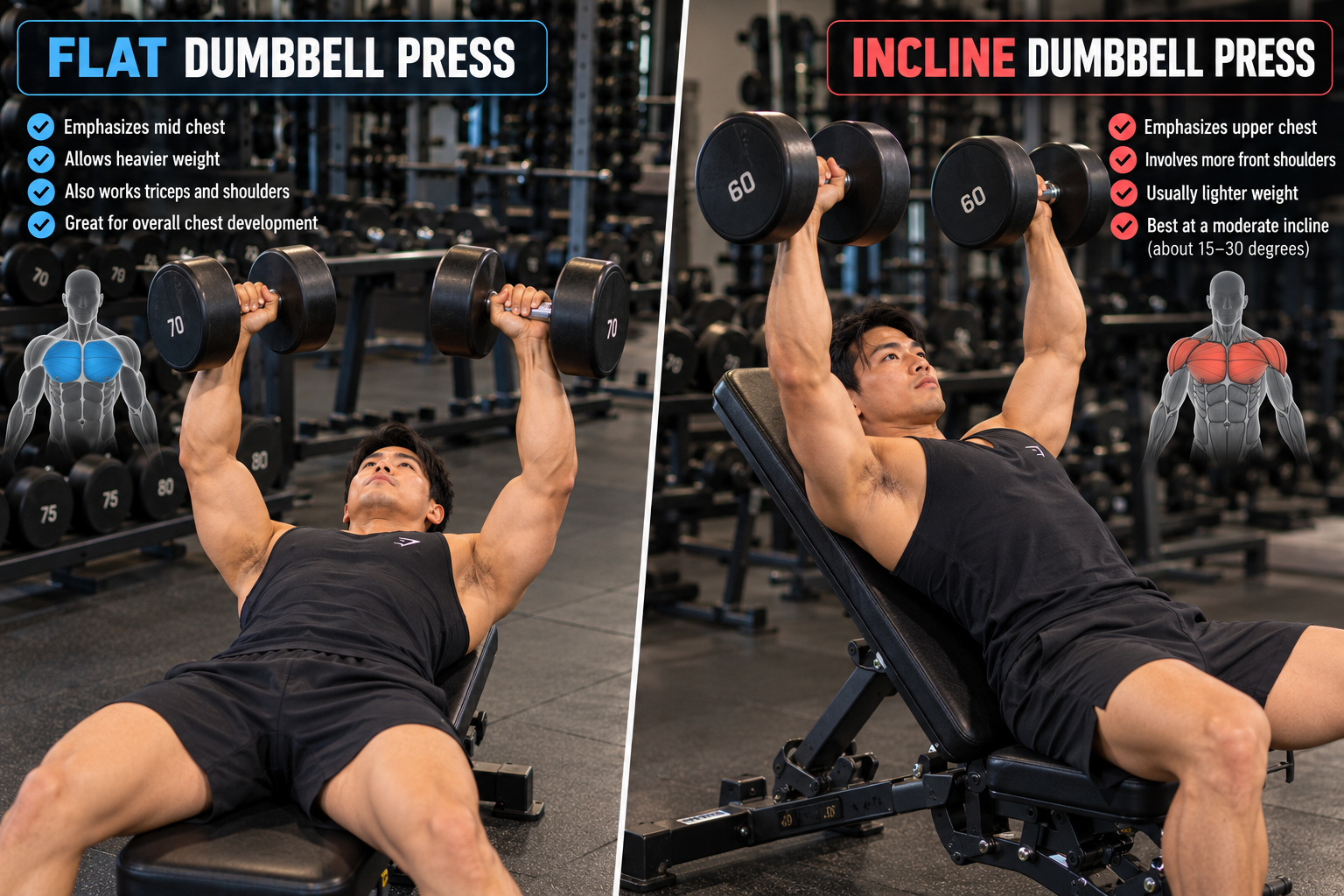
Chest workouts are one of those parts of strength training where a small adjustment can make an exercise feel surprisingly different. Two movements that demonstrate this are the incline dumbbell press and the flat dumbbell press. Both involve pressing weights away from my chest, but changing the angle of the bench affects how the exercise feels and which muscles are emphasized.
For a long time, I thought of incline and flat presses as two versions of essentially the same exercise. I figured that as long as I was training my chest, the angle probably didn't matter all that much. The more I learned about strength training, however, the more I realized that bench position can make a meaningful difference.
The flat dumbbell press is probably the more familiar of the two exercises. I lie on a flat bench, position the dumbbells near my chest, and press them upward while keeping the movement controlled. It's a straightforward exercise that allows me to train my chest while also involving my triceps and shoulders.
One thing I appreciate about the flat press is how stable and predictable it can feel once I get into position. The bench supports my upper body, and I can concentrate on moving the weights through a comfortable range of motion. Because I'm not pressing at an upward angle, I can often handle more weight than I would with an incline press.
The incline dumbbell press changes things by raising the backrest of the bench. Instead of lying completely flat, my upper body is positioned at an angle, which changes the direction of the pressing movement. That adjustment can increase the emphasis on the upper portion of my chest while also involving more of my front shoulder muscles.
I used to assume that a steeper incline would automatically mean a better upper-chest workout. But raising the bench too high can gradually make the exercise resemble a shoulder press rather than a chest press. A moderate incline, often around 15 to 30 degrees, can be a useful starting point, although the best angle depends on comfort, anatomy, and training goals.
Sometimes the smallest adjustment makes the biggest difference in how an exercise feels.
Something else I've noticed is that the incline press can feel more difficult even when I'm using lighter dumbbells. Part of that comes from the change in leverage and the muscles contributing to the movement. I don't consider the lower weight a sign that I'm getting weaker, because the two exercises aren't identical tests of strength.
This is where comparing the numbers can become misleading. If I can perform a flat dumbbell press with a certain weight, I shouldn't automatically expect to use the same dumbbells on an incline. I'd rather evaluate each exercise separately and track whether I'm improving at that particular movement.
Another difference is how I position myself before starting a set. With a flat bench, getting the dumbbells into position is usually fairly familiar. On an incline bench, I have to pay more attention to how I'm seated and how I bring the weights up without losing control.
I think the setup is especially important when the dumbbells start getting heavier. Even if I can press the weight comfortably once I'm in position, getting into and out of that position safely is part of the exercise. I don't want to choose a weight that requires awkward movements just to begin the set.
The incline bench also makes me more aware of how my shoulders feel during pressing exercises. Some angles feel natural, while others can create an uncomfortable position at the bottom of the movement. Rather than forcing myself to use a particular angle because someone recommends it, I prefer finding one that allows controlled repetitions without unnecessary joint discomfort.
The same principle applies to the flat dumbbell press. Lowering the weights as far as possible isn't automatically better if I lose control or put my shoulders into an uncomfortable position. I want a useful range of motion that challenges my chest without turning every repetition into a test of flexibility.
There's also an important difference between ordinary muscular effort and pain. If either exercise causes sharp pain, persistent discomfort, or unusual symptoms around my shoulders or chest, I wouldn't try to solve the problem by simply pushing through it. Adjusting the exercise may help with comfort, but ongoing or concerning symptoms deserve appropriate medical evaluation.
One question I find interesting is whether I actually need both exercises in the same workout. Since they emphasize slightly different portions of the chest, including both can make sense when I want some variety in my pressing routine. However, that doesn't mean I need to perform every possible chest exercise to get a productive workout.
If I'm already doing several chest movements, adding both flat and incline dumbbell presses might create more volume than I need. I have to consider the rest of my workout, how many sets I'm performing, and whether I'm recovering well enough between sessions. More exercises don't automatically produce better results if I'm simply repeating similar movements without a clear purpose.
I don't need every variation of an exercise to have a complete workout.
I also think exercise order can influence how each movement feels. If I perform flat dumbbell presses first, my chest and triceps may already be tired when I move to the incline bench. That can make the incline press feel considerably harder than it would if I performed it at the beginning of the workout.
For that reason, I wouldn't judge an exercise entirely by the weight I can lift after several other sets. If improving my incline press becomes a priority, it might make sense to perform it earlier while I'm relatively fresh. If my focus is on flat pressing strength, I can prioritize that movement instead.
Another thing I appreciate about dumbbells is that each arm has to contribute independently. Unlike a barbell, where both hands control the same piece of equipment, dumbbells require me to manage two separate weights. That can make differences in coordination or control more noticeable, regardless of whether I'm using a flat or incline bench.
At the same time, I don't think dumbbells are automatically superior to barbells or machines. Each option has advantages, and the best choice depends on what I'm trying to accomplish. For me, dumbbell presses are useful because they offer flexibility in hand position and allow me to find a movement path that feels comfortable.
When deciding between incline and flat presses, I try to think about what my current workout needs. If I want to emphasize my upper chest, an incline press is a reasonable choice. If I want a general chest pressing movement that allows me to work with relatively heavier dumbbells, the flat press may be more appropriate.
I also don't feel obligated to switch between them constantly. Keeping an exercise in my routine for a while makes it easier to recognize whether I'm improving my strength, control, and consistency. Changing the bench angle every workout might provide variety, but it can also make progress harder to measure.
What I've learned is that a small adjustment doesn't necessarily make an exercise better or worse. It simply changes the demands of the movement, and those differences can be useful when I understand what I'm trying to train. The incline and flat dumbbell presses are both effective options, but they don't need to serve exactly the same purpose.
These days, I look at them as two tools rather than competing exercises. I can choose one, include both when appropriate, or alternate between them depending on my routine. What matters most is performing them comfortably, using a manageable weight, and making progress over time.
The biggest takeaway for me is that I don't need to chase the perfect bench angle or assume that one version of a chest press is always superior. Understanding how each exercise works gives me more flexibility when planning my workouts. Sometimes changing the angle is useful, and sometimes the exercise I'm already doing is exactly what I need.
A better workout isn't always about adding something new; sometimes it's about understanding what I'm already doing.
Make sure to check out the Kato Tam fitness coach website for workout tips, daily nutritional insights, fitness motivation and more!